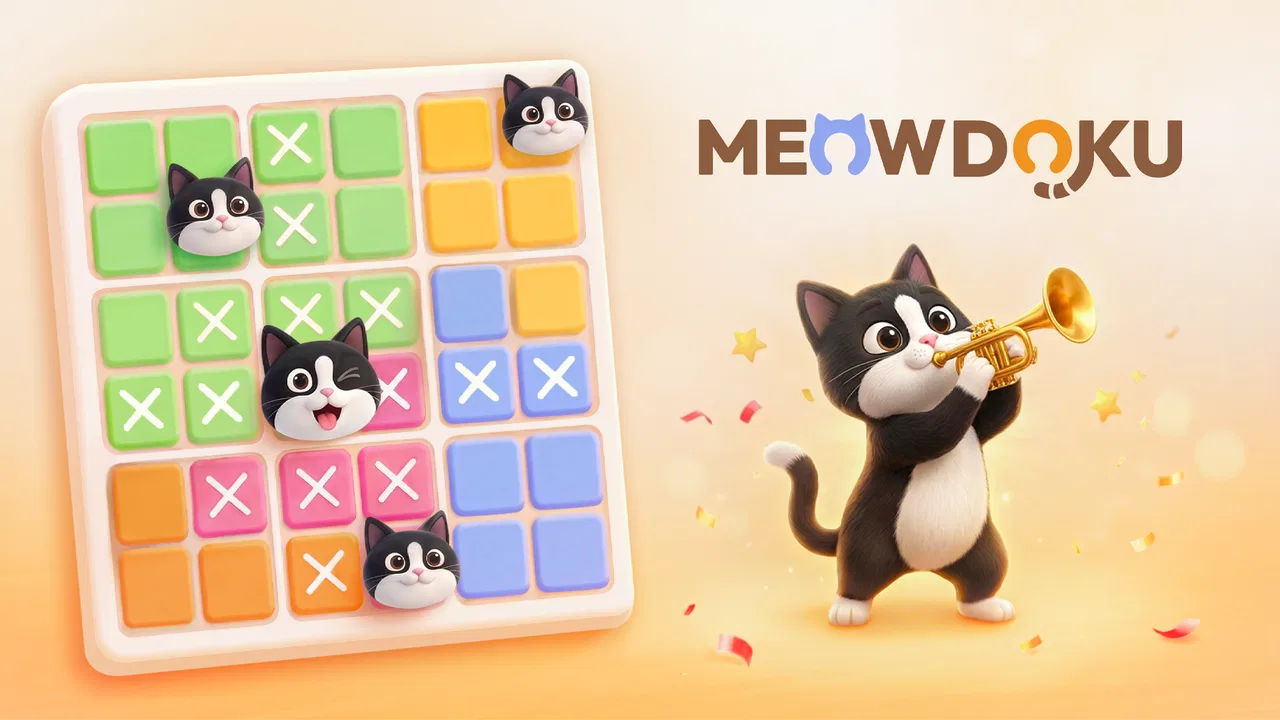
Meowdoku: Brain Puzzle Games
- 4.7
- Rating
- 10.00M
- Installs
- Free
- Price

 Analysis by App-foxy
I went into Meowdoku: Brain Puzzle Games expecting a small logic diversion, but its central idea gives it a more distinctive feel than a standard number puzzle. It combines the careful deduction of Sudoku with the danger-and-information balance associated with Minesweeper, then presents the board as a search for every cat’s territory. That combination makes each move feel less like filling empty squares and more like building a case from clues.
This is a free puzzle game from Oakever Games, aimed at Everyone and available for devices running Android 7.0 or later. It sits in a useful middle ground: familiar enough for anyone who has played classic grid puzzles, but different enough to reward a fresh approach. I would not describe it as a fast reflex game or a large adventure. Its appeal is quieter. I open it when I want to concentrate for a few minutes, test a deduction, and stop when my attention starts to wander.
The game has already attracted over 500 thousand installs, with a 4.6 average from around 8 thousand ratings and 779 written reviews. Those figures suggest that the concept is connecting with puzzle players, although numbers alone do not tell me whether it will match your preferred kind of challenge. The more important question is how you like to think: through tidy numerical patterns, cautious risk management, or a mixture of both.
You May Also Like

 Pandora - Music & Podcasts
Pandora’s Music Is Easy to Start, but Harder to Recover
Pandora’s strength is its low-effort path from a seed to a station. Its weak spot is how much confidence it asks you to place in connection, setup, and quiet recovery.

 AccuWeather: Weather Radar
AccuWeather Review: A Quick, Clear Forecast for Everyday Decisions
For everyday plans, the best forecast is the one you can understand quickly. AccuWeather makes rain timing, radar, and local conditions easy to act on, with a few trade-offs.

 Hill Climb Racing
Why Hill Climb Racing Still Turns Crashes Into One More Run
A tiny car, a bumpy hill and one more upgrade: Hill Climb Racing keeps resurfacing because its simple chaos makes every near-miss feel personal.

 AliExpress - Shopping App
AliExpress Makes Global Shopping Feel Personal, but Shoppers Bear the Risk
AliExpress turns a global marketplace into a pocket-sized discovery engine. Its reach is useful, its shopping loop compelling, and its trade-offs easy to miss.

 Lords Mobile: Kingdom Wars
Lords Mobile Is a Kingdom-Building Routine, Not a Quick Match
A case-by-case verdict on the building, battles, device demands, and social commitments that make Lords Mobile rewarding for some players and exhausting for others.

 PDF Scanner app - TapScanner
TapScanner Makes Paperwork Easier to Capture, Check, and Share
TapScanner makes scanning with a phone feel less like a rescue operation and more like a dependable step in getting work done. Its capture tools are useful, though not flawless.
More From Our News Desk
View All News


How to decide whether this puzzle fits you
The first decision point is whether you enjoy deduction that develops gradually. In a conventional Sudoku, I can scan rows, columns, and boxes while narrowing down possible numbers. In Minesweeper, I interpret nearby clues to decide where danger may or may not be hiding. Meowdoku asks me to bring those habits together. The board’s cat-territory theme gives the puzzle personality, but the real attraction is the mental shift between certainty and probability.
That makes it a better choice for someone who likes solving a board in stages rather than receiving constant rewards. A satisfying turn is often not the final answer itself, but the moment when several small clues suddenly support one safe conclusion. I find that especially appealing after a busy day, because the game gives my attention one contained problem instead of asking me to manage a long story, inventory, or collection system.
It is also worth considering how much tolerance you have for mistakes. The Minesweeper side of the design means that careless guesses can carry more weight than they would in a purely numerical puzzle. I recommend playing slowly at first and treating every revealed clue as useful evidence. If you prefer games where every move is obviously safe, this may feel tense rather than relaxing. If you enjoy reading a board and accepting calculated uncertainty, that tension becomes part of the fun.
Another useful criterion is session length. This is the kind of game I can imagine opening while waiting for an appointment, sitting on public transport, or taking a short break between tasks. It does not require the emotional commitment of a story-driven game. At the same time, a puzzle can hold my attention longer than a disposable matching game because I want to finish the reasoning process rather than simply pass time.
The cat theme matters more than it might seem. It does not turn the game into a pet simulator, nor does it replace the logic with decoration. Instead, it gives an abstract grid a memorable identity. Players who find traditional Sudoku visually plain may appreciate that extra character. Players seeking detailed cat interactions should understand the distinction: the cats frame the puzzle objective, while deduction remains the main event.
What makes the hybrid design work
The strongest part of the experience is the way familiar rules can lead me into unfamiliar decisions. I start with the habits I know from Sudoku, looking for constrained spaces and relationships between neighboring areas. Then the Minesweeper influence changes the question. I am not only asking which answer belongs in a square; I am asking what a clue tells me about the surrounding territory and which conclusion is safe to draw next.
That structure creates a helpful learning curve without requiring the game to explain every thought for me. I can begin with obvious placements, use those results to reduce the remaining possibilities, and return to areas that initially seemed ambiguous. The important technique is to avoid treating each clue in isolation. A clue that appears weak on its own can become decisive after one nearby territory has been identified.
My practical advice is to scan the whole board before committing to a difficult move. New players often focus on the most visually interesting cluster and miss a simpler deduction elsewhere. I get better results by marking the areas with the fewest plausible outcomes, resolving those first, and then using the new information to revisit the crowded sections. This is a small change in workflow, but it prevents a lot of unnecessary guessing.
A second useful habit is to separate confirmed information from a working theory. When I think I have found a cat’s territory, I treat it as a conclusion only after checking how it affects neighboring clues. If the surrounding evidence becomes inconsistent, I know that I have probably promoted an assumption too early. This makes the game feel more like logical bookkeeping than random trial and error, which is exactly why it stands apart from casual tap-to-match puzzles.
I also recommend resisting the urge to restart immediately after a mistake. A flawed position can still teach me which clue I misunderstood and why the board became impossible. That makes failed attempts valuable practice. For someone learning the hybrid rules, replaying with attention to the first questionable decision is more useful than simply trying to move faster on the next board.
Where it wins against familiar puzzle choices
Compared with ordinary Sudoku, Meowdoku offers a more exploratory rhythm. Sudoku is excellent when I want a clean system built around numbers and structured elimination. Its strength is precision. This game adds a layer of spatial interpretation, so I am reading relationships across the board rather than only checking formal rows, columns, or boxes. That extra layer can make the experience feel more active without turning it into an action game.
Compared with classic Minesweeper, the appeal is the opposite. Minesweeper is often defined by its direct danger clues and the possibility that a position may force a difficult choice. Here, the Sudoku influence gives me additional ways to narrow the board. I am not relying solely on the nearest numbers; I am combining local evidence with broader territory logic. For players who like Minesweeper but want more structure, that blend is the clearest reason to try it.
It also compares favorably with match-three games when I want mental engagement rather than automatic momentum. Match-three titles are usually better for quick visual stimulation and immediate feedback. This one asks me to slow down, remember relationships, and accept that a correct move may not produce a dramatic reward. I would choose Meowdoku when I want to exercise concentration, not when I want a burst of color and speed.
Against word puzzles, the decision depends on what kind of thinking you enjoy. A crossword or word game tests vocabulary, spelling, and associations. This game avoids language knowledge and instead rewards observation and deduction. That makes it more approachable when I want a puzzle that does not depend on knowing obscure words, but less satisfying if the pleasure for me comes from clues, definitions, or clever phrasing.
One non-obvious advantage is how well the game can serve as a transition activity. I can use a board to move from a noisy environment into a focused state because the rules are compact but the decisions are meaningful. I would not call it a meditation tool, since mistakes and uncertainty can be stimulating, but it can replace aimless scrolling with a short task that has a clear endpoint.
Where another category may suit you better
I would skip this game if I mainly want a story, character progression, or a sense of exploration beyond the board. The cat framing may make the puzzle more inviting, but it does not change the fact that the core activity is logic solving. Someone looking for a cozy game with decorating, collecting, or pet care should choose a different type of experience.
I would also point a highly competitive player toward a puzzle with explicit time trials, leaderboards, or versus play if those features are the reason they play. Meowdoku’s appeal, in my experience, is the quality of the deduction rather than public comparison. Even a very difficult board can feel personal: I am trying to understand the evidence in front of me, not beat another player’s score.
Players who dislike uncertainty should consider standard Sudoku instead. Sudoku generally lets me proceed through logical certainty, while the Minesweeper influence can make a move feel riskier. That does not make the design unfair by itself, but it changes the emotional texture. If I want a completely controlled puzzle where every step follows a familiar numerical method, the traditional option is likely the calmer choice.
On the other hand, experienced Minesweeper players who want pure speed may find the hybrid approach slower than they prefer. The added Sudoku-style reasoning is the point, but it also means I cannot always rely on rapid pattern recognition. The game rewards patience, cross-checking, and a willingness to reconsider a promising idea. That is a strength for thoughtful players and a possible friction point for specialists seeking quick board clearance.
The age rating of Everyone makes the game easy to recommend across a household, especially when one person wants a quiet, nonviolent puzzle that another family member can understand. Still, an Everyone rating does not mean every player will enjoy it equally. Younger players may need time to understand how the two logic traditions interact, while adults who already know both may want more demanding boards before the concept feels fully rewarding.
What switching from another puzzle costs
Moving from Sudoku is relatively easy because the basic mindset of elimination carries over. The cost is mostly mental adjustment: I have to stop expecting every clue to behave like a conventional Sudoku clue and start paying attention to territory relationships. My first few sessions feel better when I focus on understanding the board rather than measuring how quickly I solve it.
Moving from Minesweeper requires a different adjustment. I need to give up some of the instinct to work only from immediate numerical clues and consider how a larger arrangement limits the possibilities. If I approach the game as “Minesweeper with cats,” I miss much of its identity. The better approach is to treat the familiar Minesweeper logic as one tool inside a broader deduction system.
Switching from a casual matching game can be more demanding. There is no guarantee that every tap will create a satisfying chain, and a board may require me to pause before acting. I see that as a reasonable trade-off, but it means the game is not ideal for moments when I have only enough attention for automatic play. A short session still works, yet I need to be mentally present for it to feel good.
The current version is 1.3.1, and the game is free to start. That removes the biggest financial barrier to trying the concept. My recommendation is to judge it by the first few boards rather than by the cat theme alone. If the combination of local clues and broader territory deductions feels satisfying, the free entry makes experimentation easy. If I find myself guessing without enjoying the reasoning, no amount of charming presentation will fix that mismatch.
One practical switching tip is to play with a consistent solving routine. I begin by identifying the most restricted spaces, record only conclusions I can defend, and then rescan the board after every meaningful discovery. This keeps the hybrid rules from becoming a blur. It also helps me tell whether I dislike the game itself or simply approached it with the wrong habits from another puzzle category.
My recommendation for different kinds of players
I recommend Meowdoku to people who want a free logic game with more personality than a plain number grid and more structure than a casual matching title. The blend of Sudoku-style deduction and Minesweeper-style clue reading gives it a clear identity. Oakever Games has chosen a concept that is easy to describe but more interesting to play once I start combining evidence across the board.
It is particularly suitable for a daily puzzle routine. I can play one board during a coffee break, return later when I have more focus, or use it as a deliberate replacement for aimless phone browsing. The best results come when I slow down, inspect the entire layout, and treat every confirmed territory as information that changes the rest of the puzzle.
I would not recommend it to someone who wants a narrative game, instant rewards, or purely familiar Sudoku rules. I would also hesitate for players who become frustrated whenever a puzzle asks them to manage uncertainty. In those cases, a traditional Sudoku app, a word puzzle, or a fast arcade-style alternative may be a better match, depending on whether you want certainty, language, or speed.
For everyone else, the risk of trying it is low because the game is free and rated Everyone, while the potential reward is a puzzle format that feels genuinely different from its ingredients. Its strongest quality is not simply that it combines two famous ideas; it is that the combination changes how I read the board. The right reason to install it is the pleasure of turning scattered clues into one confident conclusion.
After spending time with it, my final view is positive but specific: this is a focused puzzle game for patient thinkers, not an all-purpose mobile distraction. The cat theme makes the presentation approachable, the hybrid logic gives the gameplay its hook, and the compact format makes it easy to fit into ordinary breaks. If you enjoy Sudoku and Minesweeper but want a board that asks you to use both kinds of reasoning at once, Meowdoku: Brain Puzzle Games is a recommendation I can make without hesitation.
FAQs for Meowdoku: Brain Puzzle Games
01What is Meowdoku: Brain Puzzle Games?
Meowdoku: Brain Puzzle Games is a mobile app that combines the classic Sudoku puzzle format with a playful cat-themed twist. It offers a range of difficulty levels, making it suitable for both beginners and seasoned puzzle enthusiasts. The game focuses on enhancing cognitive skills while providing a fun, engaging experience.
02Is Meowdoku suitable for all ages?
Yes, Meowdoku is designed for players of all ages. Its intuitive interface and adjustable difficulty levels make it accessible for children, while the more challenging puzzles provide enough complexity to keep adult users engaged. It’s a great way for families to enjoy puzzle-solving together.
03Does Meowdoku require an internet connection?
No, Meowdoku does not require a constant internet connection to play. You can enjoy all the puzzles offline. However, certain features, like leaderboard updates or downloading new puzzle packs, might require you to be online. This makes it perfect for on-the-go gaming without worrying about connectivity.
04Are there in-app purchases in Meowdoku?
Yes, Meowdoku offers in-app purchases. While the app is free to download and play, users can purchase additional puzzle packs or remove ads for a more seamless experience. These purchases are optional and the game is fully playable without spending money.
05How does Meowdoku help improve cognitive skills?
Meowdoku challenges players with puzzles that boost problem-solving skills, enhance memory, and improve concentration. By engaging with different levels of difficulty, users can progressively sharpen their analytical thinking and pattern recognition abilities, making it a beneficial app for mental exercise.
Pros
- Engaging puzzles keep users entertained.
- Visually appealing and intuitive design.
- Regular updates with new levels.
- Suitable for all age groups.
- Encourages strategic thinking and planning.
Cons
- Occasional in-app ads can be disruptive.
- Some levels may feel repetitive.
- Limited free hints available.
- Requires internet for certain features.
- May not appeal to non-puzzle lovers.

Meowdoku: Brain Puzzle Games
Gallery